
Santhal Resistance Movement
- Santhal Resistance Movement
Historical Context
Tilka Manjhi defended tribal customs, sacred groves, and ritual practices as symbols of identity and unity. His resistance was not only armed but cultural—protecting traditions, values, and indigenous heritage from colonial interference.

British East India Company Expansion
The expansion of the British East India Company into tribal regions brought administrative control, military presence, and interference in indigenous systems.

Revenue Policies & Land Displacement
Heavy taxation and new revenue systems disrupted traditional land ownership, leading to exploitation and displacement of tribal communities.

Impact on Santhal Autonomy
Colonial policies weakened tribal self-rule, undermined village councils, and threatened the Santhals’ control over their ancestral lands and forests.
Revolt Against British Rule
Tilka Manjhi led one of the earliest organized tribal revolts against British colonial authority in the late 18th century.
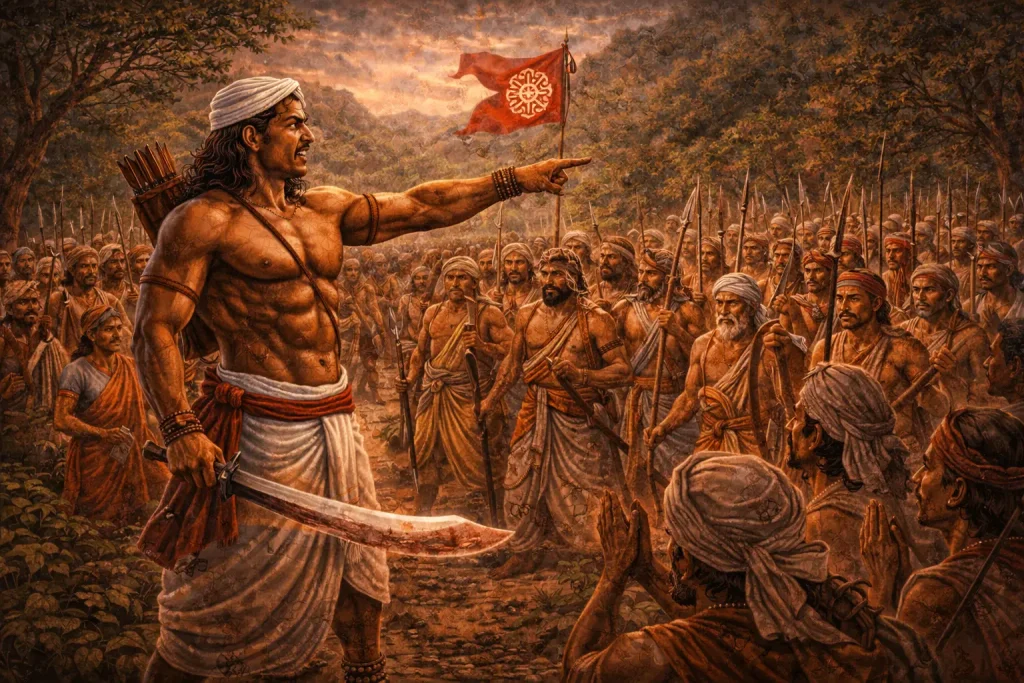
Attack on British Officials
In 1784, Tilka Manjhi launched a bold attack on British authority, reportedly targeting Collector Augustus Cleveland.This act symbolized open defiance and marked one of the earliest direct tribal challenges to colonial rule.
Local Uprising in the Bhagalpur Region
The resistance spread across villages in the Bhagalpur region, mobilizing tribal communities.
These uprisings disrupted British administration and strengthened indigenous unity.
Guerrilla Warfare & Mobilization
Attack on British Officials (1784)
Tilka Manjhi led a daring assault against British authority, famously targeting Collector Augustus Cleveland as a direct challenge to colonial power.
Forest-Based Guerrilla Warfare
He used dense forests and hilly terrain to launch surprise attacks, avoiding open-field confrontations with better-armed British troops.
Defense of Tribal Villages
Tilka organized fighters to protect Santhal settlements from raids, forced taxation, and confiscation of resources.
Mobilization Across Regions
He coordinated resistance among Santhal and Pahadia communities, expanding the struggle beyond a single village or clan.
Strategic Night Ambushes
His forces conducted planned night-time operations, disrupting British camps and supply routes.
Final Stand and Capture (1785)
After prolonged resistance, he was captured by British forces, marking the end of a major phase of armed tribal defiance.
Guerrilla Warfare & Mobilization
Tilka Manjhi’s resistance against British rule was marked by strategic guerrilla warfare and effective grassroots mobilization. Operating in the forested regions of present-day Bihar and Jharkhand during the late 18th century, he understood that direct confrontation with the well-armed British forces would be difficult. Instead, he adopted flexible, terrain-based tactics that gave tribal fighters a strategic advantage.The dense forests, hills, and river valleys of the region became natural shields and battlegrounds. Tilka Manjhi and his followers used their deep knowledge of the land to launch sudden ambushes on British patrols, revenue officials, and supply routes. These surprise attacks disrupted colonial administration and created constant pressure on British authorities. By striking swiftly and retreating into the forest, tribal fighters avoided prolonged battles while maintaining psychological dominance.Mobilization was equally central to his strategy. Tilka Manjhi traveled across villages, rallying Santhal and neighboring tribal communities under a shared cause—defense of land, dignity, and self-rule. Communication networks were built through traditional methods such as drum signals, messengers, and community gatherings. These systems allowed rapid coordination across dispersed settlements without relying on written communication.